
Estimated reading time: 11 minutes
Looking for a CO alarm Quebec homeowners can actually rely on? In 2026, protecting your family is not only about having a detector that makes noise. It is about connecting your smoke and carbon monoxide sensors to a monitored alarm system that can trigger help even when you are asleep, away from home, or unable to respond.
It was a Tuesday night in Brossard — February 11, 2025. A couple in their mid-fifties had gone to bed around 10:30 PM. Their gas furnace, installed in 2009, had developed a hairline crack in its heat exchanger. No smell. No visible smoke. Just carbon monoxide quietly building up through the ductwork while they slept.
Table of contents
- 1. What an integrated CO alarm Quebec system actually means
- 2. CO alarm Quebec legal requirements in 2026
- 3. Standalone CO alarm vs integrated smoke and CO detector
- 4. Why Quebec winters make CO alarm integration more important
- 5. How an integrated smoke and CO alarm system works
- 6. CO alarm Quebec installation mistakes to avoid
- 7. FAQ — CO alarm Quebec and smoke detector integration
- Articles liés
1. What an integrated CO alarm Quebec system actually means
An integrated smoke or CO detector is a sensor that doesn’t just sound an alarm in the room where it’s installed — it communicates directly with your alarm control panel, which in turn notifies a 24/7 monitoring centre the moment it triggers.
This is the fundamental difference from a battery-operated standalone alarm: one makes noise and hopes you hear it, the other activates a response whether you’re awake, home, or 800 km away.
The chain of protection a standalone alarm can’t complete
Smoke and CO tend to strike hardest during sleep. Carbon monoxide in particular is colourless, odourless, and undetectable without equipment. Early symptoms — headaches, nausea, drowsiness — closely resemble a bad flu. Many victims simply drift deeper into unconsciousness, never realizing anything is wrong.
An integrated sensor bypasses this chain of human failure entirely. You don’t need to be awake. to be home. or your phone on loud. The system acts for you.
2. CO alarm Quebec legal requirements in 2026
Quebec’s regulations are frequently misunderstood — and that misunderstanding leaves real families at real risk.
Regulatory snapshot — What Quebec law actually requires:
Since April 1, 2019, installing a carbon monoxide alarm is legally mandatory in any Quebec residence that meets at least one of these conditions:
- Presence of a fuel-burning appliance (wood stove, gas fireplace, gas water heater, oil furnace, etc.)
- A wall, floor, or ceiling adjacent to a room containing a fuel-burning appliance
- An attached garage — even if it has no direct interior door into the living space
A CO alarm must be installed on every storey that contains sleeping areas.
Sources: Régie du bâtiment du Québec (RBQ), Safety Code Chapter VIII, Article 359; City of Quebec municipal bylaw in force since April 1, 2019.
In plain terms: if you have an attached garage in the greater Montreal, Laval, Longueuil, Brossard, or Quebec City area — and the overwhelming majority of single-family homes built before 2015 do — you are legally required to have CO alarms installed.
Yet on nearly every diagnostic visit we do with new clients, we find the same situation: a smoke alarm that’s been on the ceiling since 2008, and no CO alarm anywhere in the house. It’s not carelessness. It’s that almost no one ever explained this clearly.
The numbers behind the risk
Key statistics — Fire safety in Quebec:
- Over 16,600 fires occur in Quebec every year — more than 45 per day (Gouvernement du Québec, fire safety statistics)
- In a declared residential fire, occupants have less than 3 minutes to evacuate safely (Quebec.ca)
- Functional smoke detectors reduce the risk of dying in a house fire by 50% (Canadian fire safety research, 2025)
- In 2024, the Quebec City fire department (SPCIQ) distributed 3,174 smoke alarms and 1,160 CO alarms during its 58,000 residential prevention visits — a clear indicator of how widespread the gap in protection still is (SPCIQ Annual Report 2024)
3. Standalone CO alarm vs integrated smoke and CO detector
| Feature | Standalone alarm (battery) | Integrated alarm sensor |
| Local audible alert | ✅ Yes | ✅ Yes |
| Alerts you while sleeping | ⚠️ Only if you hear it | ✅ Control panel takes over |
| Alerts when you’re away | ❌ No | ✅ Monitoring centre notified |
| Smartphone notification | ❌ Not on basic models | ✅ Yes, via panel app |
| Automatic 911 contact | ❌ No | ✅ Yes, via monitoring centre |
| Whole-home interconnect | ⚠️ Possible (RF models) | ✅ Native via control panel |
| False alarm management | ❌ Manual only | ✅ Cancel code via keypad |
| ULC certification required | ✅ Mandatory (ULC logo) | ✅ Mandatory (CAN/CSA-6.19) |
| Typical device cost | $35–$85 | Included in system installation |
| Useful lifespan | 7–10 years | 7–10 years |
| Insurance recognition | Minimal | Often recognized by insurers |
My straight opinion on this: A $45 alarm from Canadian Tire is better than nothing. But if you already have a home alarm system and your smoke and CO sensors aren’t wired into your panel — you are paying for incomplete protection. It’s like putting a deadbolt on the front door and leaving the basement window wide open.
4. Why Quebec winters make CO alarm integration more important
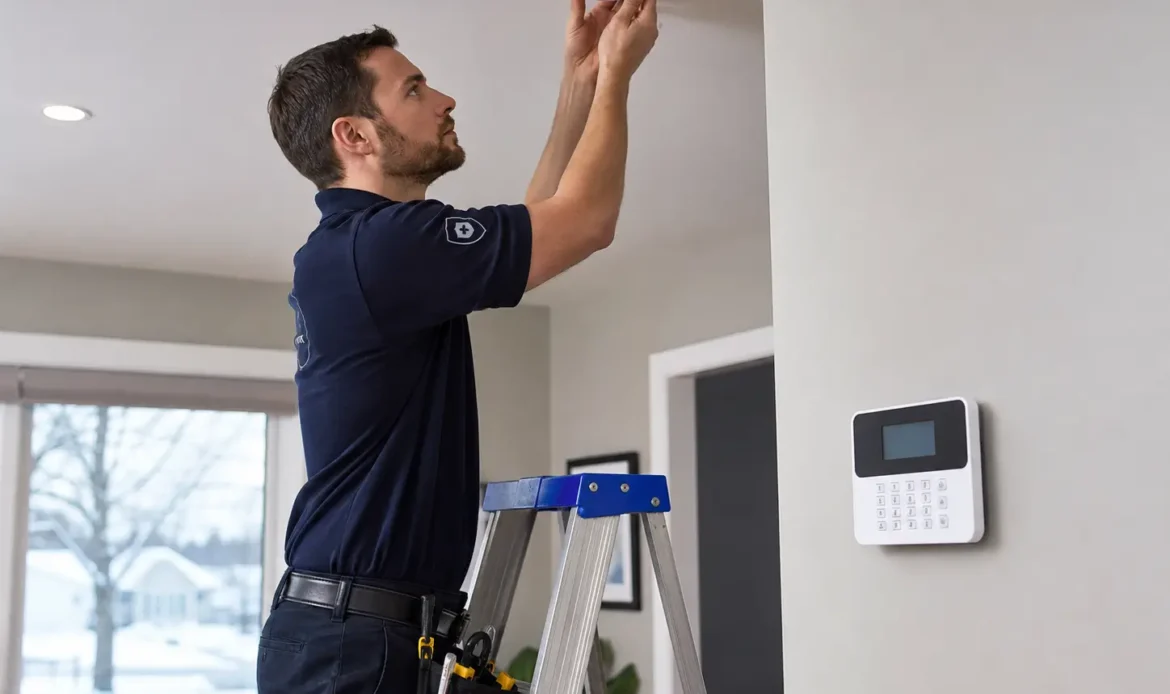
Carbon monoxide is a risk that Quebec’s specific climate actively amplifies — and this is something you won’t read in most generic guides.
Between November and March, Quebec homeowners seal their homes tight, run fuel-burning appliances continuously, and — this one is chronically underestimated — warm up their cars in attached garages “just for two minutes” on a -18°C morning.
An attached garage, even without a direct interior door, can allow CO to migrate into the living space through poorly sealed drywall joints, electrical outlets, and shared HVAC systems. The RBQ incorporated exactly this scenario into its mandatory regulations, and that’s not a coincidence.
What happened in Longueuil — November 2025
A client I’ll call Robert D., who owns a 1980s split-level in Longueuil, called us on November 17, 2025 — the morning after his neighbour was taken to hospital for CO exposure. The neighbour had been warming up an older diesel truck in a semi-enclosed garage for about 10 minutes. No CO alarm in the house. His wife found him confused and unsteady near the kitchen door.
Robert called us the next morning. He didn’t just want a CO alarm — he wanted everything tied into his existing alarm panel. “If he’d had what you can install,” he told me, “the ambulance would have shown up before his wife had to call 911 herself.”
He was right. Two weeks later, Robert had 2 integrated CO sensors (basement + main floor) and a photoelectric smoke sensor near his gas kitchen installed and active. Total cost of the integration on top of his existing contract: $312.
5. How an integrated smoke and CO alarm system works
Integrating a smoke or CO sensor into a residential alarm system follows a clear four-step chain:
- Step 1 — Detection.
The sensor (photoelectric for smoke, electrochemical for CO) continuously samples the air. The moment readings exceed ULC-certified thresholds, it sends a signal to the panel.
- Step 2 — Panel registers the event.
Your control panel logs the alert with a precise zone identifier — “Zone 4 — Kitchen smoke” or “Zone 6 — Basement CO.” That granularity helps firefighters go directly to the right location.
- Step 3 — Signal transmitted to monitoring centre.
The panel contacts the monitoring centre via cellular, IP, or phone line — typically within 30 seconds of the initial trigger.
- Step 4 — Emergency protocol activates.
The operator attempts to reach you via your pre-set contact list. If no one responds or the situation is confirmed as an emergency, they contact 911 directly. This happens even if you’re travelling, even if your phone is dead, even if you’re incapacitated.
What no standalone alarm can do — no matter the price
Even the Google Nest Protect at $139 CAD cannot call 911 on your behalf. It can push a notification to your phone — if you have cellular signal, if you’re awake, if your phone isn’t muted. That’s three “ifs” too many when your family is asleep.
6. CO alarm Quebec installation mistakes to avoid
I’ll be direct here, because the same errors come up on almost every diagnostic visit.
Mistake #1 — Installing the CO sensor on the ceiling
Carbon monoxide has a density very close to air — it disperses throughout a room rather than rising. Standard CAN/CSA-6.19 recommends installation at breathing height, roughly 1 to 1.5 metres from the floor — not on the ceiling like a smoke alarm. A ceiling-mounted CO sensor will still detect CO eventually, but less efficiently at low concentrations where early intervention matters most.
Mistake #2 — One CO alarm for the whole house
The RBQ is explicit: a CO alarm is required on every storey containing sleeping areas in homes with an attached garage. A single unit on the main floor does not cover the basement or second floor.
Mistake #3 — Thinking a monitoring-connected smoke detector replaces the required standalone alarm
As the Gouvernement du Québec states directly: “A smoke detector connected to a monitoring centre does not replace a smoke alarm required” by the Safety Code. The two can coexist in a single 2-in-1 device — but the legal requirement for an audible alarm is separate from the monitoring function.
Mistake #4 — Ignoring the 10-year replacement rule
Any smoke alarm must be replaced 10 years from the date of manufacturing as indicated on its casing. If no manufacturing date is indicated, or if it has become illegible, the alarm must be replaced immediately. Check the back of every device in your home right now. On nearly every pre-sale home inspection we support, we find alarms from 2010 or earlier still in place.
Mistake #5 — Placing smoke alarms too close to the kitchen
Photoelectric detectors are less sensitive to steam and work well near kitchens or bathrooms. The RBQ and the City of Quebec both specifically recommend keeping smoke alarms away from kitchens, fireplaces, and bathrooms to avoid nuisance trips from cooking smoke and steam. If your alarm trips every time you make toast, people start taking the battery out — and that’s when the real danger begins.
7. FAQ — CO alarm Quebec and smoke detector integration
No. A standard smoke alarm does not detect carbon monoxide. They use completely different sensor technologies. Only combination 2-in-1 devices (like the First Alert SCO5CN) detect both. If your smoke alarm is a single-function unit, you need a separate CO alarm — or a combined sensor integrated into your alarm panel.
Yes. Since April 1, 2019, if your residence has an attached garage — whether or not it connects directly to the interior — you are legally required to have a CO alarm on every storey with sleeping areas. Source : Code de sécurité du Québec, chapitre VIII, article 359.
Photoelectric sensors are better at detecting slow, smouldering fires (mattresses, wiring, plastics) that produce a lot of smoke before igniting. They also generate fewer false alarms near kitchens. Ionization sensors detect fast-flaming fires more quickly. The RBQ recommends photoelectric sensors for residential use. An integrated system can use both types in different zones for full coverage.
Several Quebec insurers offer premium reductions for monitored alarm systems. Adding integrated CO sensors can strengthen that recognition. I recommend calling your broker directly — some of our clients have received 10–15% annual premium reductions after full system installation. Worth a 10-minute phone call.
The real question isn’t whether you have a detector
In Quebec in 2026, having a smoke alarm is a legal baseline, not a safety strategy. The real question — the one too few homeowners ask — is this: can your detector act for you when you are unable to act for yourself?
A standalone alarm is a passive tool. It beeps into the dark at 3 AM and hopes someone hears it. An integrated sensor connected to a monitored alarm system is an active part of your protection chain — it does not simply beep, it triggers a response.
The good news: integration costs far less than most homeowners expect. And for families with children, single-story homes where bedrooms are far from risk zones, or secondary properties left unoccupied for weeks at a time, this protection becomes genuinely non-negotiable.
Protect your family with an integrated alarm system
Want to know if your home is properly protected against smoke and carbon monoxide? Request a free diagnosis of your residential alarm system.